
(This article originally appeared in the TAU-USA Fall 2025 Issue #117)
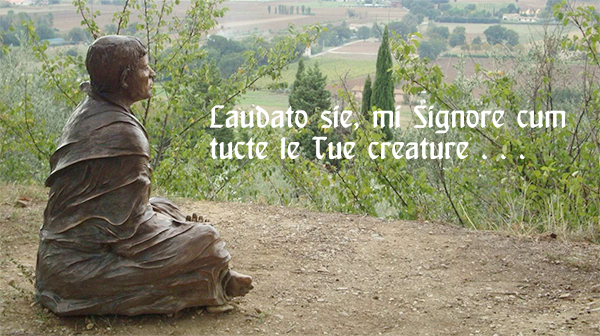
“For His praise, I wish to compose a new hymn about the Lord’s creatures, of which we make daily use, without which we cannot live, and with which the human race greatly offends its Creator.” St. Francis of Assisi, 1225
This year marks the eighth centenary of St. Francis’ beloved Canticle of the Creatures, a hymn of praise that has inspired generations to see all of creation as a reflection of God’s goodness. At our recent National Chapter, the formation session was dedicated to reflecting on this beautiful song of praise.
We began by listening to a recording of the Canticle sung in Italian by the Choir of the Diocese of Rome. The beauty of the prayerful music drew us into a place of peace and openness to the Spirit. Together, we then joined our voices in English, reading and praying the words of the Canticle in unison. The shared prayerful reading reminded us that we are truly brothers and sisters, united in the family of creation and in fraternity with one another.
Our session explored the three stages in which the Canticle took shape, each offering insight into how Francis viewed God, humanity, and the created world:
Verses 1–9 lift up the elements of creation – sun, moon, wind, water, fire, and earth – praising God through them. These verses were written during a time of deep suffering in Francis’ life, when illness and physical pain weighed heavily on him. Yet his heart overflowed ipraise: “I wish to compose a new hymn about the Lord’s creatures…” (The Assisi Compilation, 83).
Verses 10–11 followed soon after, written to inspire reconciliation and peace between the civil and religious leaders of Assisi. The Canticle became not only a hymn of creation but also a call to healing and harmony among people.
Verses 12–13, composed near the end of Francis’ earthly journey, welcome “Sister Bodily Death” with reverence and trust, completing the hymn with a profound acceptance of life’s final passage into God.
Each participant was invited to reflect on which verse spoke most deeply to them. In small groups, we shared our experiences of how the Canticle inspires or challenges us today.
As part of the centenary celebration, Vicki Klick, Centenary Taskforce Chair, shared a video meditation created by Taskforce member Carolyn Townes: Reflective Meditation on the Canticle of the Creatures. This prayerful video combined Francis’ words with images of creation submitted by our Secular Franciscan brothers and sisters from across the country.
The session closed with a copy of the Canticle being distributed, along with guiding reflection questions. We were encouraged to carry these into the quiet of Eucharistic Adoration, letting the words of Francis lead us more deeply into prayer, gratitude, and praise.
Eight hundred years later, St. Francis’ Canticle of the Creatures continues to remind us of the intimate bond we share with all creation. It calls us to see every element of the natural world as a brother or sister – gifts given by the Creator, meant for our care, reverence, and joy.
Reflection Questions
Kinship with Creation
- Identify ways in which Saint Francis emphasizes human kind’s kinship with creation.
- How might this view of our relationship with creation affect how we live and how we treat nature?
Pardon and Peace
- When and how have you received the gift of forgiveness in your life?
- What relationships or situations in your life are calling out for forgiveness?
Sister Bodily Death
- How do we die as a Franciscan person?
- How and in what ways do you give your life away?
Good morning eace be with you all Iam Marcelline Nsini Iam interested to be a secular Franciscain kindly let me know you process for formation .