
(This article originally appeared in the TAU-USA Spring 2026 Issue #120)
By Diane Menditto, OFS • National Vice Minister
As we continue our celebration of the “Easter of St. Francis,” our attention now turns to his relationship with God. For the theme of this issue of the TAU, we have chosen the Prayer Inspired by the Our Father (FA:ED, vol.1, p.158). This prayer is one of the clearest windows into St. Francis’s inner spirituality: contemplative, Trinitarian, and centered on God’s overflowing goodness. It is an authentic Franciscan text preserved in the earliest manuscript collections and universally accepted by modern scholars. “Two thirteenth-century examples of this type of commentary on the Lord’s Prayer suggest that this style of prayer forms a ‘catechism of prayer’ offering strong attitudes toward, as well as images of, God. In fact, this writing is perhaps the only instance in which we find an example of how Francis responded to his brothers’ request to teach them how to pray.” (FA:ED, vol. 1, p. 158)
This prayer served as a formation tool for the early fraternity, shaping their understanding of God, grace, forgiveness, and the Christian life. Although Francis follows the common medieval practice of expanding each petition of a prayer through contemplative reflection, his expression remains unmistakably Franciscan: simple, warm, and wholly centered on God’s goodness. Our Seraphic Father begins the prayer by saying:
“O Our Father most holy:
Our Creator, Redeemer, Consoler, and Savior:”
St. Francis’ vision of God is Trinitarian: He is the Creator, Redeemer, Consoler, and Supreme Good. He tells us in those few words what theologians down the ages have expounded upon in thousands of pages and hundreds of volumes. Each time we say, “Our Father,” we place ourselves in the Father’s hands which is exactly what St. Francis wanted for himself and his followers – surrender.
By reading Francis’s other writings, we find that “Creator, Redeemer, Consoler, and Supreme Good” are not titles that are only found in this particular prayer. They echo a pattern found throughout his authentic writings. These titles form part of Francis’ characteristic way of naming God: effusive praise, Trinitarian structure, and an emphasis on God’s overflowing goodness. Francis’ desire to be a son of God the Father draws us into the entire Trinity and reminds us that when we say “Our Father,” we unite ourselves to the Father, Son, and Holy Spirit.
As you pray with this text and allow it to lead you more deeply into Franciscan spirituality, you may also wish to explore other instances in which Francis refers to God the Father: They can be found on the Franciscan Intellectual Tradition website: https://digitalcollections.franciscantradition.org/pages/ early-sources-table-of-contents
Just these few words will provide hours of meditation and contemplation both at home and at adoration before the Blessed Sacrament. Perhaps these questions will help you to get started:
+ How does Francis’s understanding of “Father” deepen your own understanding of the Trintiy?
+ Where do you experience God as Creator, Redeemer, or Consoler in your life?
Other References to God the Father as Creator, Redeemer, Consoler, and Supreme Good
CREATOR: Earlier Rule 23 (FA:ED, Vol. 1, p. 63.);
Praises of God (FA:ED, Vol. 1, pp. 109–110) ; Letter to the Entire Order (FA:ED, Vol. 1, p. 116) Also read the background provided for each writing.
REDEEMER: Earlier Rule 23; Letter to the Entire Order
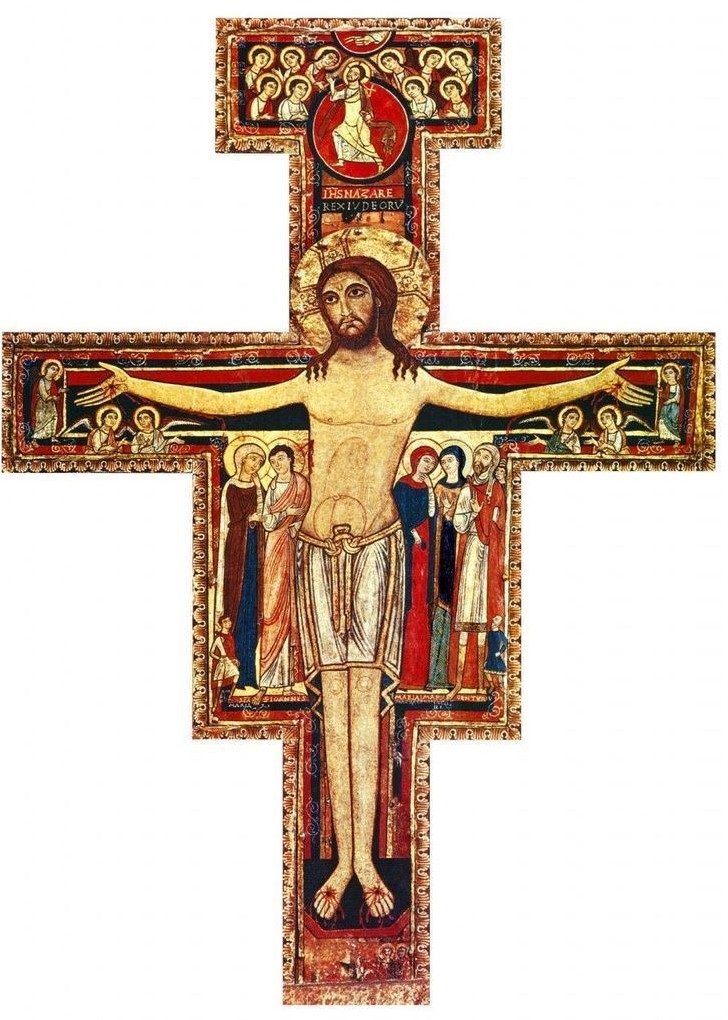
CONSOLER: Implied in the Prayer Before the Crucifix; Office of the Passion (God who comforts, enlightens, guides) (FA:ED, Vol. 1, p. 40)
SUPREME GOOD: Praises of God; Earlier Rule 23; Letter to the Entire Order; Office of the Passion (FA:ED, Vol. 1, p. 139)

Leave A Comment